
Menu
Close
Revenue Cycle Management Services That Maximize Every Dollar You Earn
Optimize your revenue cycle with accurate billing, faster reimbursements, and expert claims management all backed by certified coders and HIPAA-compliant processes.
Years serving providers
Why BridgeCore
Many claim denials stem from preventable issues such as incomplete patient information, eligibility verification errors, missing prior authorizations, inaccurate coding, or payer-specific submission requirements. Left unchecked, these problems lead to delayed reimbursements, increased administrative workload, and unnecessary revenue loss.
BridgeCore Billing combines experienced billing professionals with proven revenue cycle management strategies to identify denial trends, resolve claim issues quickly, and improve first-pass claim acceptance. Through proactive monitoring, accurate documentation, and continuous process improvement, we help your practice minimize denials, maximize reimbursements, and maintain a healthier revenue cycle.
Service Benefits
Everything your revenue cycle needs
From eligibility to reporting a complete billing operation, delivered as a service.
Submit clean claims within 24 hours and shorten your A/R days significantly
Professional individuals across every major specialty — ICD-10, CPT, HCPCS
AI-assisted scrubbing catches errors before submission, cutting denials up to 40%.
Consistent posting, follow-ups, and appeals drive predictable monthly revenue.
Real-time eligibility and benefits checks reduce surprises at the point of care.
Weekly dashboards and KPIs give you full visibility into every dollar.
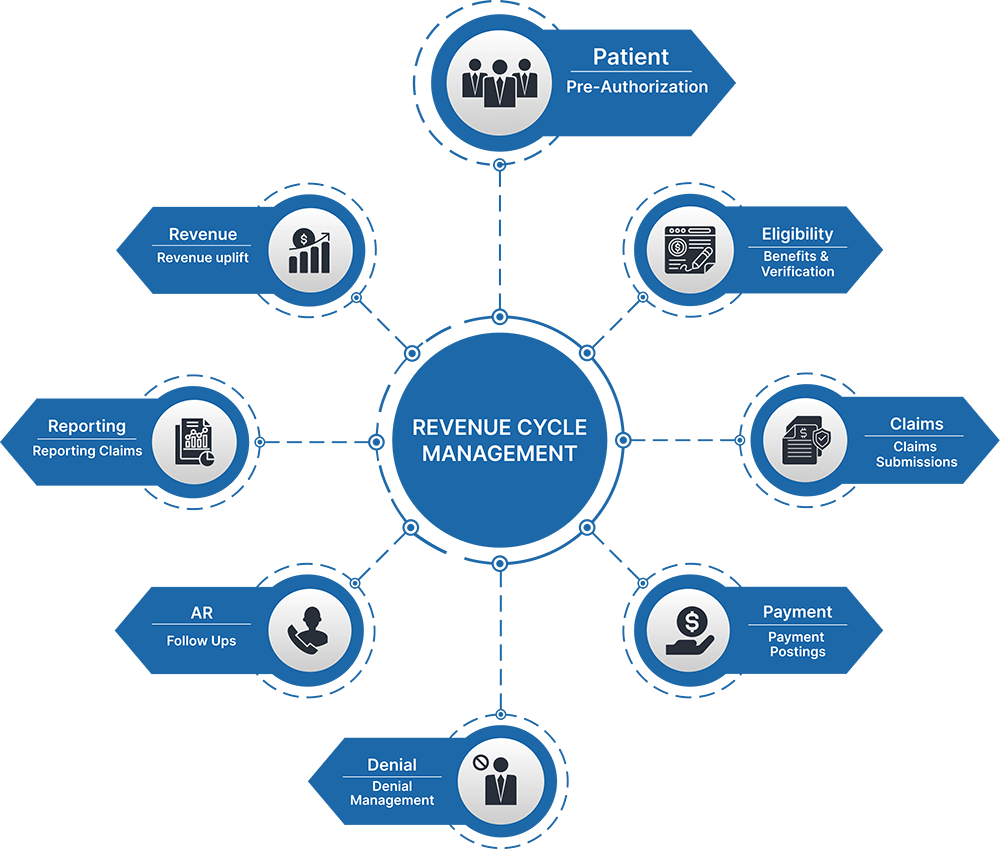
Our End-to-End Revenue Cycle Management Process
Our end-to-end revenue cycle management services streamline patient registration, insurance verification, medical coding, claims processing, payment posting, and denial management to maximize reimbursements and support long-term financial growth.
Our Specialties
Deep expertise across diverse medical specialties, with knowledge of specialty-specific modifiers, payers, and billing complexities.
Claim Accuracy
Days in A/R
Revenue Monitoring
Secure Compliance
The Difference
In-House vs. Outsourced Revenue Cycle Management
From eligibility to reporting a complete billing operation, delivered as a service.
In-House Revenue Cycle Management
Bridge Core Billing RCM Services
How Bridge Core Billing Helped a Healthcare Provider Increase Monthly Collections
The healthcare provider was struggling to identify payment discrepancies due to complex payer contracts and manual verification processes. This resulted in missed revenue opportunities, delayed reimbursements, and undetected underpayments.
| Metric | Before | After |
|---|---|---|
| Monthly Collections | $160,000 | $1,500,000+ |
| Days in A/R | 68 days | 32 days |
| Clean Claim Rate | 78% | 94% |
| Contract Accuracy | Manual, error-prone | 100% automated |
| Payment Verification | 8–12 hours/day | Real-time |
| Underpayment Detection | Reactive | Proactive ($480K/mo avg) |
FAQ
Answers to common questions
Everything you need to know before partnering with Bridge Core.
Revenue cycle management (RCM) in healthcare is the end-to-end financial process that tracks a patient’s account from appointment scheduling and insurance verification through medical coding, claim submission, and final payment collection. It connects clinical, administrative, and financial workflows so providers are reimbursed accurately and on time for services delivered. The healthcare revenue cycle is generally grouped into three stages: front-end (scheduling, registration, eligibility verification), mid-cycle (charge capture and CPT/ICD-10 coding), and back-end (claim submission, denial management, accounts receivable, and collections).
Revenue cycle management is important because it protects a practice’s cash flow and financial stability, ensuring providers actually collect the revenue they earn. Effective RCM reduces claim denials, lowers days in A/R, improves the clean claim rate, and increases net collections directly strengthening profit margins. It also improves the patient’s financial experience through accurate billing and upfront cost estimates, while supporting regulatory compliance and long-term sustainability.
Healthcare RCM is complex because most payment comes from third-party payers Medicare, Medicaid, and commercial insurers each with different rules, fee schedules, prior authorization requirements, and timely filing deadlines. Constantly changing CPT, ICD-10, and HCPCS codes, the shift toward value-based care, and compliance demands like HIPAA and the No Surprises Act add further layers. Because a single error in eligibility, coding, or documentation can trigger a denial, accuracy is required at every stage of the cycle.
Medical billing is a subset of revenue cycle management focused mainly on coding, claims submission, and payment collection after care is delivered. Revenue cycle management (RCM) is the complete financial process from patient scheduling and insurance eligibility verification to claims, denial management, and final payment that includes billing as just one step. In short, billing is reactive and claims-focused, while RCM is a proactive, end-to-end strategy for maximizing revenue and reducing denials.
We reduce claim denials and days in A/R by catching problems upstream and working every claim through to payment. Core levers include real-time eligibility and benefits verification, accurate CPT/ICD-10 coding with claim scrubbing to push the clean claim rate above 95%, prior authorization tracking, root-cause denial management with timely appeals, and proactive A/R follow-up segmented by aging bucket and payer. The target is industry-benchmark performance, a denial rate under 5% for top-performing practices and days in A/R in the 30–40 day range.
Yes, our RCM services are built to scale with your practice as you add providers, open new locations, expand into new specialties, or increase claim volume. Coding capacity, billing workflows, and denial management flex with demand, so performance holds steady as throughput rises. Real-time dashboards keep KPIs like days in A/R, denial rate, and net collections visible as you grow, giving you enterprise-grade revenue cycle support without hiring and training additional in-house billing staff.
Ready to see what a modern revenue cycle looks like?
Most practices are fully onboarded within 2–3 weeks. Our transition team handles data migration, credentialing continuity, and payer notifications with zero disruption to daily operations.